Are rising energy costs, condensation complaints, and compliance pressure forcing you to re-evaluate refrigerator door performance? Many procurement teams still overlook one core metric that directly drives these problems—U value.
U value measures how much heat passes through a refrigeration glass door. Lower U value means better insulation, lower energy loss, more stable cabinet temperature, and fewer operational issues like fogging and frost under real store conditions.

Yet U value is not just a number on a datasheet. It reflects glass structure, cavity design, edge sealing, and manufacturing precision—factors that directly impact lifetime energy cost, service frequency, and your product’s competitiveness in export markets.
What Is U Value in Refrigeration Applications?
When specifying glass doors, you may face inconsistent technical claims and vague “energy-saving” labels. Without a clear definition of U value, comparing suppliers objectively becomes risky and expensive.
U value is thermal transmittance expressed in W/m²·K. It quantifies how much heat flows through a door when there is a temperature difference between inside and outside—lower values mean stronger insulation performance.
How U Value Is Determined
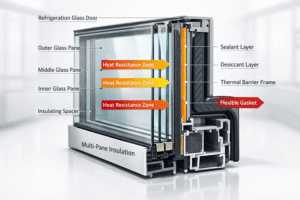
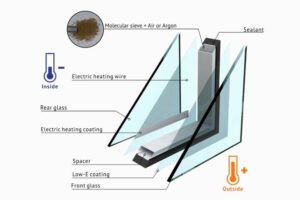
U value depends on the complete glass assembly, not just a single pane:
- Glass thickness and composition
- Air, argon, or vacuum cavity
- Spacer material and edge seal quality
- Coatings such as Low-E
In refrigeration, even a 0.3 W/m²·K difference can change compressor load and frost formation over time—especially in high-traffic stores.
Typical U Value Ranges in Refrigeration
| Door Type | Typical U Value |
|---|---|
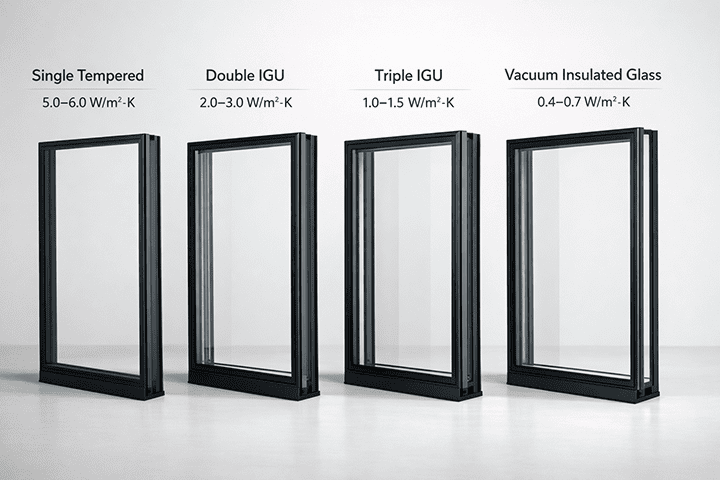
| Single tempered glass | 5.0–6.0 W/m²·K |
| Double insulated glass (IGU) | 2.0–2.8 W/m²·K |
| Triple insulated glass | 1.4–1.8 W/m²·K |
| Vacuum insulated glass (VIG) | 0.6–1.0 W/m²·K |
Lower U values correlate with reduced heat gain and lower operating energy demand in heat transfer fundamentals (See Source).
What Is the R Value of a Glass Door—and Why Do Some Buyers Ask for It?
If your buyers or engineering team also work with building specs, you may see R value appear in RFQs. Confusion happens when teams compare U-value doors with R-value documents without converting correctly.
R value measures resistance to heat flow. Higher R value means better insulation. For the same door, R value is the inverse of U value when using consistent units.
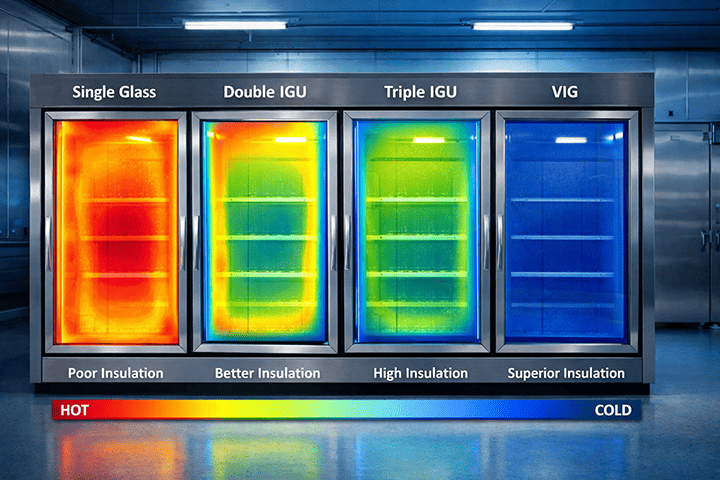
Typical R Values for Glass Doors (Approx.)
| Glass Type | Approx. R Value (m²·K/W) |
|---|---|
| Single glass | 0.17–0.20 |
| Double IGU | 0.35–0.50 |
| Triple IGU | 0.55–0.70 |
| VIG | 1.0–1.7 |
In refrigeration, U value is the more common and more directly actionable specification—but knowing R value prevents conversion mistakes during cross-market sourcing.
What Is the Difference Between U Value and R Value of Glass?
Procurement teams often treat U value and R value as two different “performance claims,” which leads to duplicated requirements, wrong comparisons, or mismatched targets.
U value measures heat transfer rate (lower is better). R value measures thermal resistance (higher is better). They describe the same insulation performance from opposite directions and are mathematically reciprocal.
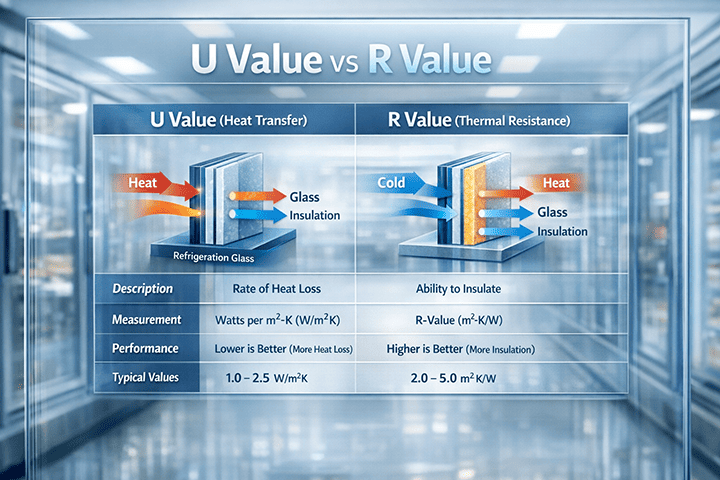
U Value vs R Value (Buyer-Friendly Summary)
| Metric | What It Represents | Better Performance |
|---|---|---|
| U value | Heat transfer rate | Lower value |
| R value | Thermal resistance | Higher value |
If two suppliers publish different metrics, you can still compare them fairly—once you convert them correctly.
How Do You Calculate the U Value of Glass?
Some suppliers publish U values without explaining how they are calculated, what boundary conditions are used, or whether edge effects are included. That is a procurement risk.
U value is calculated by analyzing heat transfer through all layers of the glass system, including panes, gas or vacuum gaps, coatings, spacers, and surface resistances.
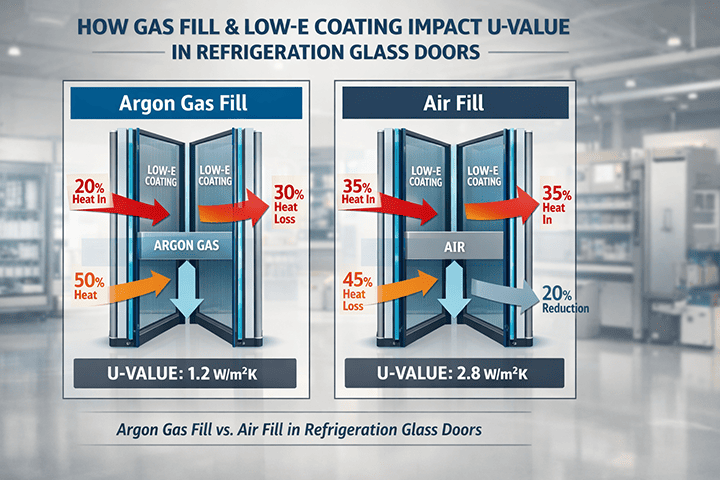
Simplified Calculation Components (What Actually Moves the Number)
| Component | Influence on U Value |
|---|---|
| Glass thickness | Moderate |
| Gas fill (air/argon) | High |
| Vacuum cavity | Very high |
| Low-E coating | High |
| Edge spacer & seal | Moderate |
For credible comparability, calculations should follow established standards such as EN 673 or ISO 10292-style methodologies and clearly state assumptions (temperature difference, convection coefficients, and measurement region).
How Do You Convert R Value to U Value?
In bid comparisons, a single conversion error can push you toward an inferior door system—and you will not see the cost until energy bills and service tickets arrive.
Convert with the inverse relationship: U = 1 ÷ R (using the same unit system). This provides a consistent basis for comparing doors across regions and documents.
Example Conversion
- If R value = 0.5 m²·K/W
- U value = 1 ÷ 0.5 = 2.0 W/m²·K
Practical rule: if a supplier gives only R value, you can still build a U-value-based spec and maintain a clean procurement standard.
How Does U Value Affect Energy Consumption and Operating Cost?
Energy efficiency is no longer optional. For supermarkets, beverage brands, and cold-chain operators, refrigeration accounts for a large share of electricity usage—and glass doors are a measurable pathway of heat gain.
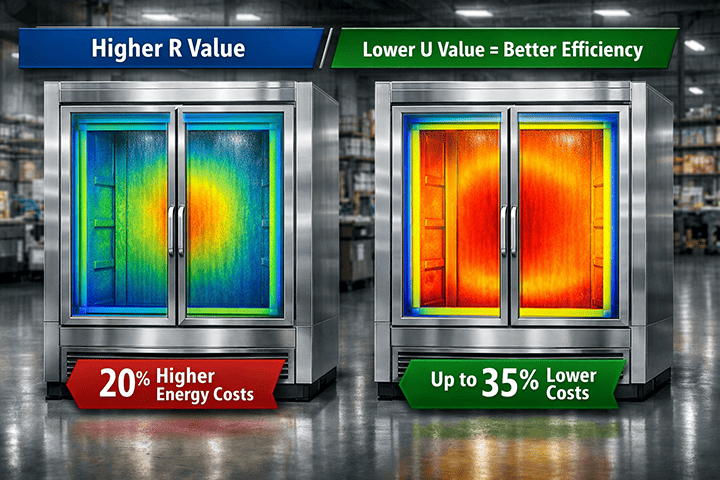
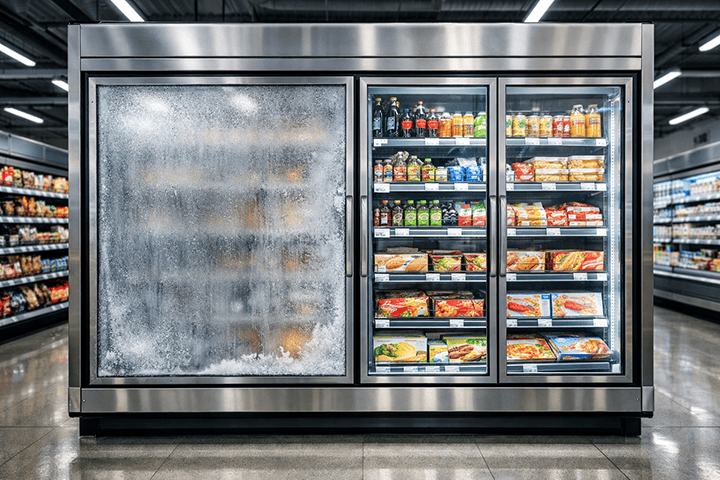
Lower U value reduces heat infiltration, so compressors cycle less frequently. This lowers electricity consumption, reduces defrost demand, extends equipment life, and stabilizes cabinet temperatures.
Real Cost Impact Over Time
Consider a multi-door commercial freezer operating 24/7:
- High U value doors allow continuous heat gain
- Compressors work harder to maintain −18 °C
- More defrost cycles increase energy use and wear
Improving insulation and reducing heat gain is recognized as a lever to reduce commercial refrigeration energy use (See Source).
Hidden Benefits Beyond Energy
Lower U value also supports:
- Reduced condensation and fogging
- Better product visibility and shopper conversion
- Improved temperature stability for food safety
- Fewer service calls caused by icing and moisture problems
For you, this is not only a technical improvement. It is a procurement decision that affects your brand’s total cost of ownership.
What U Value Should You Specify for Refrigerator and Freezer Doors?
A common mistake is chasing the lowest U value without considering the application. Overengineering can increase BOM cost, complicate assembly, or add unnecessary weight—without proportional ROI.
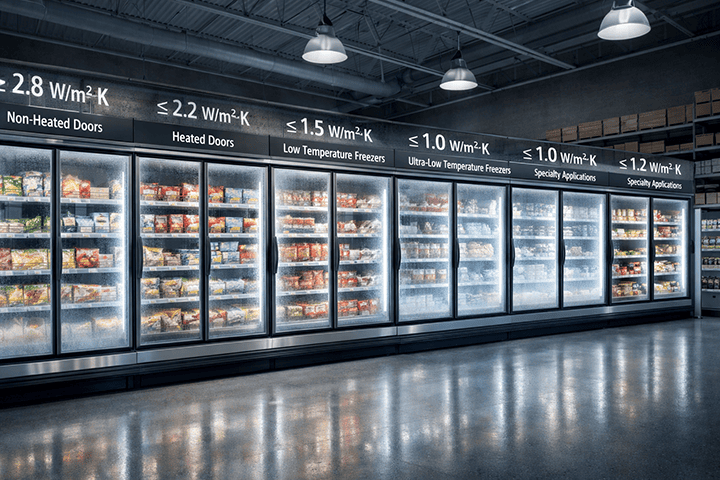
For coolers (0 °C to +5 °C), U values below 2.5 W/m²·K are typically sufficient. For freezers (−18 °C or lower), U values below 1.8 W/m²·K are strongly recommended.
Matching U Value to Application
| Application | Recommended U Value |
|---|---|
| Beverage coolers | ≤2.8 W/m²·K |
| Supermarket chillers | ≤2.2 W/m²·K |
| Ice cream freezers | ≤1.8 W/m²·K |
| Ultra-low temp cabinets | ≤1.2 W/m²·K |
Procurement Tip: Specify the System, Not Just the Glass
Your door performance depends on more than IGU/VIG:
- Door frame insulation
- Heater wire layout and control logic
- Gasket sealing and closing force
A low-U glass unit combined with poor frame design will not deliver real-world savings. For procurement, this means your RFQ should define the complete door performance target, test method, and acceptable tolerance.
IGU vs VIG: How Different Technologies Influence U Value?
Not all low U values are achieved the same way. If you do not understand the technology path behind a U value claim, you risk surprises in lead time, durability, retrofit feasibility, and warranty exposure.
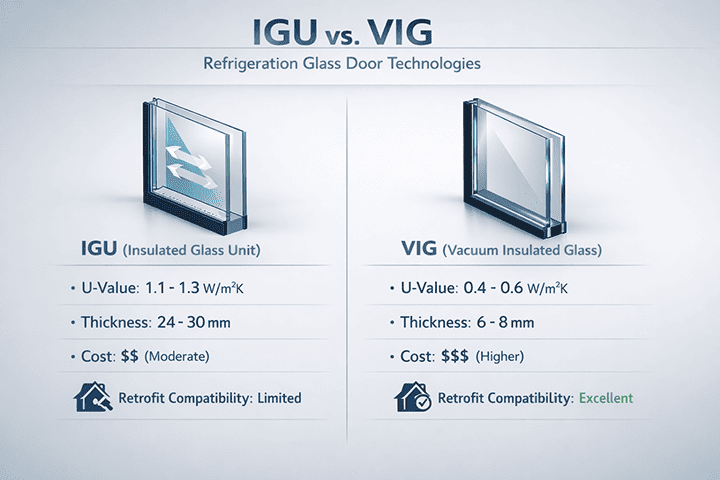
IGU reduces heat transfer using sealed gas-filled cavities, while VIG eliminates gas conduction by using a vacuum layer—achieving ultra-low U values with thinner profiles.
Technology Comparison
| Parameter | IGU | VIG |
|---|---|---|
| Typical U value | 1.8–2.8 | 0.6–1.0 |
| Thickness | 18–28 mm | 8–10 mm |
| Cost | Moderate | Higher |
| Retrofit compatibility | Limited | Strong |
How to Choose as a Buyer (MECE Decision Logic)
Choose IGU when:
- You need cost-effective mass production
- Door thickness is not a constraint
- You want mature supply chains and broad compatibility
Choose VIG when:
- You need thinner doors but lower U value
- Retrofit is important (space constraints)
- You target aggressive energy labels or premium segments
A good supplier should be able to justify the selection with measurable U-value targets, condensation performance, and verified durability—not marketing language.
How to Test U Values?
If a U value is not verified, it is a claim—not a specification. The safest way to protect your procurement decision is to require a test method and evidence that matches your application.
U values are tested in certified laboratories using controlled temperature differences, typically with guarded hot box or heat flow meter methods. Independent testing validates thermal performance claims under repeatable conditions.

How to Get the U-Value Test Report with us?
We can send the multiple glazing or complete glass door samples to an ISO/IEC 17025 accredited lab (e.g., SGS) for U value test and issue official corresponding data report.
| Test Requirement | U Value (Thermal Transmittance) | U Value (Thermal Transmittance) |
|---|---|---|
| Test Subject | Insulated Glass Unit (Glass Center Area) | Complete Glass Door Assembly (Including Frame) |
| Test Standards | ISO 10292:1994 / EN 673:2024 / GB/T 22476-2008 | ISO 10077-1/2 / EN 12412-2 / GB/T 8484 |
| Test Cost | USD 580 | USD 1,980 |
| Test Time | Around 3 weeks | Around 3 weeks |
| Sample Requirements | Insulated glass units: 2 piecesDimensions: 100 × 100 mm | Frame: 1 piece, dimensions ≤ 1900 × 1800 mmGlass door: 1 piece, dimensions ≤ 2400 × 1800 mm |